
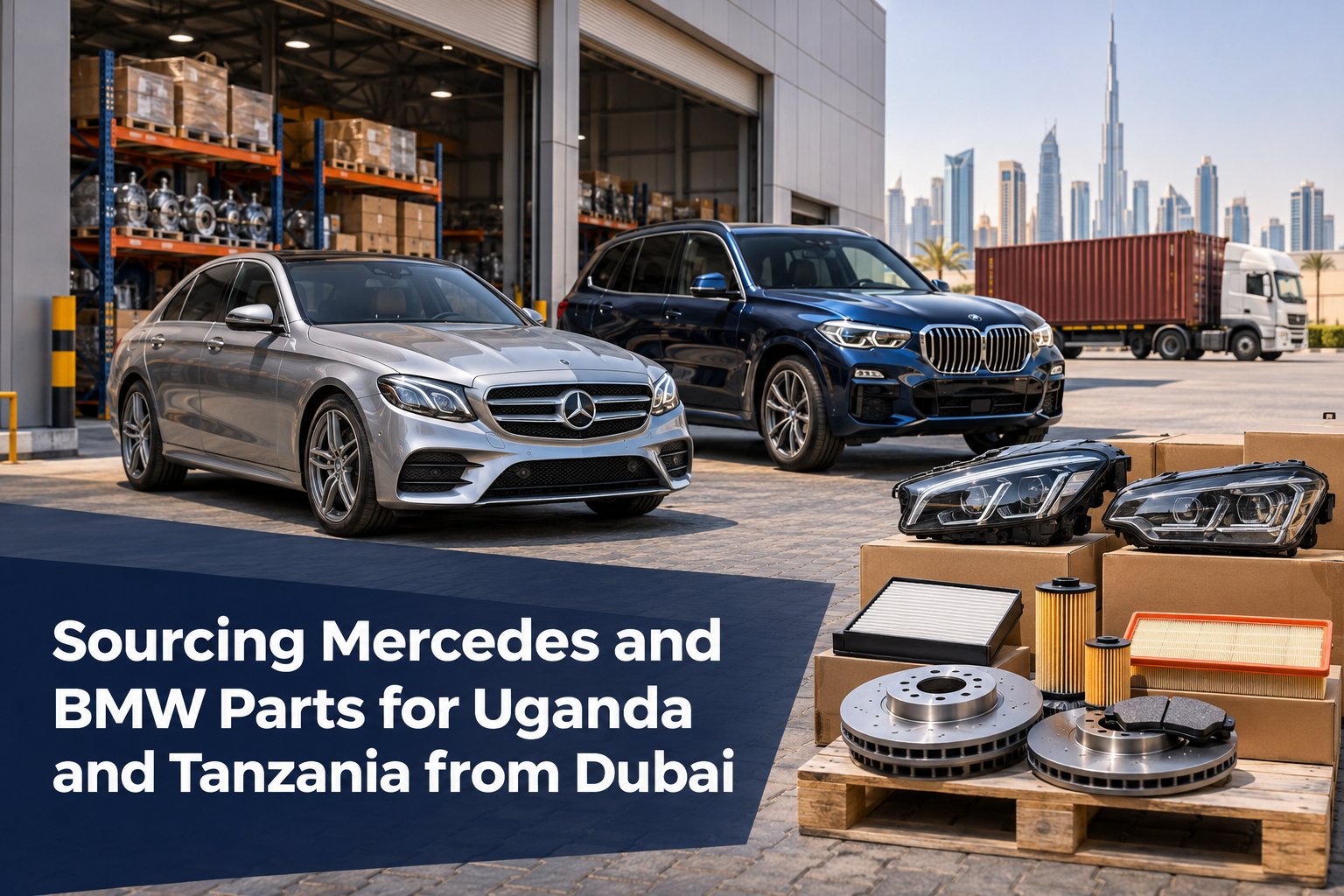
Mercedes-Benz and BMW are among the most respected premium cars on East African roads. In Kampala, Dar es Salaam, Arusha, and Entebbe, you will find E-Class sedans, X5 SUVs, and 3 Series cars that have been driven for years. Keeping them running is the hard part. Local stock of genuine parts is often limited, prices vary widely, and a wrong part can mean days of downtime.
That is why many garages, fleet owners, and importers now look to Dubai. The city is a global hub for European car parts, offering reliable auto parts export African markets. With regular shipments and access to a wide range of genuine, OEM, and aftermarket components, Dubai has become a preferred sourcing destination. This guide explains why Dubai works, how to source the right parts, and what to check before you pay.
Why Dubai is a smart source for European car parts
Dubai has one of the largest concentrations of European car parts suppliers in the region. The reasons are simple.
- Huge local car market. Mercedes and BMW are everywhere in the UAE, so suppliers stock a wide range of parts for current and older models.
- Choice of part types. You can find genuine, OEM, aftermarket and quality used parts in one place, which lets you match the part to your budget.
- Established export routes. Dubai has strong air and sea freight links to East Africa, including Entebbe, Dar es Salaam and Mombasa.
- Experienced exporters. Many suppliers already handle export paperwork, packing and shipping for African buyers.
For anyone searching for Mercedes and BMW spare parts Dubai, the choice is not just about price. It is about finding a supplier that can identify the exact part and export it safely.
Mercedes spare parts for Uganda
Uganda’s roads, climate and fuel quality put real stress on engines, suspension and cooling systems. Owners who search for mercedes spare parts Uganda usually need the following.
- Suspension components such as control arms, bushings and shock absorbers
- Brake discs, pads and sensors
- Engine mounts, filters and cooling parts
- Gearbox and transmission parts
- Lighting, mirrors and body panels after accidents
Genuine parts give the longest service life, but quality used or OEM parts can cut costs a lot on older C-Class, E-Class, GLE and Sprinter models. A good supplier will explain the difference and let you choose.
BMW spare parts for Uganda
BMW owners face a similar picture. Buyers searching for BMW spare Uganda often need parts for the 3 Series, 5 Series, X3 and X5, which are the most common models. Typical orders include:
- Water pumps, thermostats and radiators
- Engine sensors and ignition parts
- Control arms, ball joints and tie rods
- Headlights and tail lights
- Used engines and gearboxes for cost-sensitive repairs
BMW parts can differ by engine, build date and market, so exact identification matters more than the model name alone.
Mercedes and BMW spare parts for Tanzania
Tanzania has a fast-growing market for used and imported European cars, and demand for parts follows. Searches for Mercedes and BMW spare Tanzania come from three main groups:
- Independent garages that need regular stock of wear parts.
- Fleet and tour operators that need reliable parts to avoid downtime.
- Private owners who want one specific part at a fair price.
Shipping from Dubai to Dar es Salaam is a well-used route. Parts can move by air for urgent repairs or by sea for larger, planned orders. Buyers in Arusha and Mwanza usually receive goods through Dar es Salaam and then arrange onward transport.
Genuine, OEM, aftermarket or used: which should you buy?
There is no single right answer. It depends on the part, the age of the car and your budget.
- Genuine parts come in the carmaker’s own packaging. They are best for safety-critical parts and newer vehicles.
- OEM parts are made by the same manufacturer that supplies the carmaker, often at a lower price than the branded box.
- Aftermarket parts are made by other companies. Quality ranges from excellent to poor, so buy only from known brands.
- Used parts can be a very good value for body panels, lights, mirrors, engines and gearboxes, if they are tested and graded.
A simple rule: do not cut corners on brakes, steering and airbag components. Save money on cosmetic and low-risk parts.
How to order the right part the first time
Wrong parts are the most common and most expensive mistake in cross-border orders. Follow these steps to avoid it.
- Get the VIN. The 17-character Vehicle Identification Number is on the windscreen base and the registration document. It tells the supplier the exact model, engine and options.
- Find the part number if you can. It is often printed on the old part. If not, a good supplier can match it from the VIN.
- Send photos. Pictures of the old part and the area it fits in remove doubt.
- Confirm the condition. Ask whether the part is genuine, OEM, aftermarket or used, and get it in writing.
- Ask for the full quote. It should include the part price, packing, freight and any handling fees.
If you are unsure about a part number, a VIN and part number assistance service can confirm the right match before you buy.
Shipping and customs: what to expect
Export from Dubai is straightforward when the supplier handles it every day. Still, buyers in Uganda and Tanzania should plan ahead.
- Air freight is faster and suits small, urgent or high-value parts. It costs more per kilo.
- Sea freight suits heavy items such as engines, gearboxes and bulk garage orders. It takes longer but costs less.
- Customs duties and taxes differ by country, part type and condition, and rules change. Check current rules with your clearing agent or the local revenue authority before you ship.
- Packing matters. Fragile parts like lights and radiators need proper protective packing.
- Use a clearing agent at the destination port or airport to avoid delays.
How to choose a reliable supplier in Dubai
Before you send money, check the following.
- Does the supplier have a real trade licence and a physical address?
- Do they specialise in Mercedes and BMW, rather than listing every brand?
- Can they identify parts from a VIN?
- Do they have experience exporting to your country?
- Do they give clear written quotes with photos?
- What is their return or exchange policy for wrong parts?
Be careful with prices that look too good to be true. Counterfeit parts are a known risk in the global parts trade, and they can be dangerous on brakes and suspension.
Final thoughts
For garages and owners in Uganda and Tanzania, Dubai offers wide choice, competitive prices and tried-and-tested shipping routes for Mercedes and BMW parts. The key is to know your VIN, choose the right part grade and work with a supplier that understands export.