
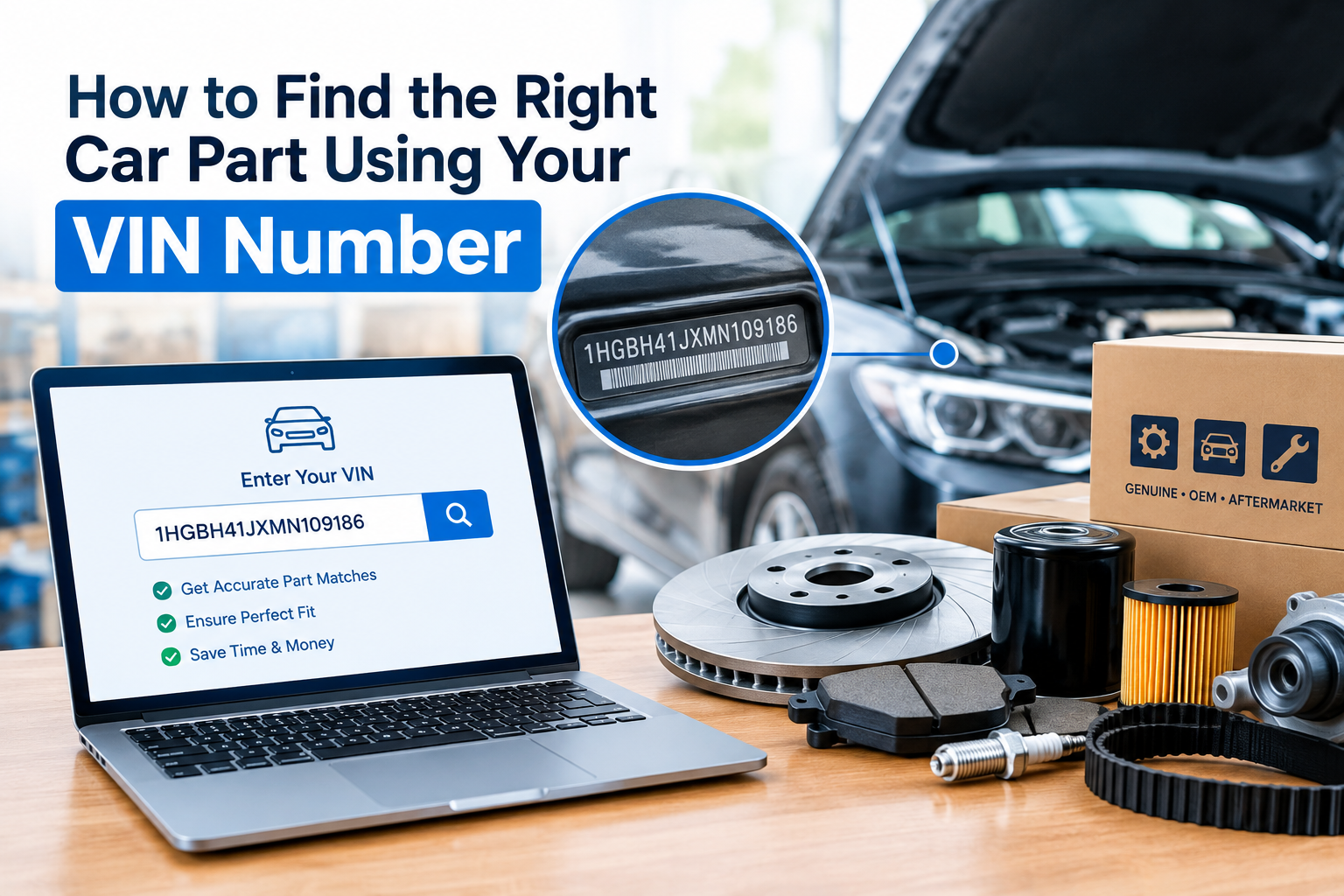
Ordering a car part only to find out it doesn’t fit is frustrating – and expensive. Between different engine options, trim levels, and small changes made across a single model year, two cars that look identical on the outside can need completely different parts underneath. The good news? Your car already carries the answer, printed right there on its VIN.
If you’ve ever wondered how to find car parts using VIN number details, this guide walks you through exactly what a VIN is, where to find yours, and how to use it to order the right part the first time — no guesswork, no returns, no wasted time.
What Is a VIN Number?
Your Vehicle Identification Number (VIN) is the unique 17-character code assigned to your car when it was built. Think of it as your vehicle’s fingerprint — no two cars share the same one. Tucked inside those 17 characters is everything about how your car was made: the model, engine type, production year, factory plant, and the exact specifications it rolled off the line with.
That’s what makes a VIN part lookup so useful. Instead of guessing based on your car’s make and model alone, you’re matching parts to the exact vehicle sitting in your driveway.
Why Your VIN Matters When Buying Car Parts
Here’s the thing most people don’t realise: the same model can hide several different versions under the hood. A car with the same badge and body style might have a different engine size, transmission, or trim depending on when and where it was built. Those small differences can mean a part that fits your neighbour’s car doesn’t fit yours.
Using your VIN takes the guesswork out of it. It tells you — and whoever’s helping you find the part — precisely what your car needs, so you’re not stuck sending something back or discovering a bad fit halfway through a repair.
Where Can You Find Your VIN?
Before you start searching for a part, track down your VIN — it only takes a minute and will save you a lot of back-and-forth later. You’ll usually find it in one of these spots:
- The bottom corner of your windscreen, on the driver’s side
- Inside the driver’s door jamb (open the door and look at the frame)
- Your vehicle registration papers
- Your insurance documents
- Past service records
Having it on hand before you contact a parts supplier makes the whole process faster and helps you get the right answer straight away.
How to Find Car Parts Using Your VIN Number
Once you’ve got your VIN, the process is simple: give the full 17-character number to a trusted parts supplier, or run it through a manufacturer-approved lookup tool. From there, your car’s exact specifications are decoded — revealing the factory-fitted components and the manufacturer part numbers that are guaranteed to match.
This works for pretty much anything on your car, from engine and suspension parts to body panels, electrical components, and interior trim — all matched to your specific vehicle rather than a generic model listing.
What Does a VIN Decoder for Auto Parts Actually Do?
A VIN decoder auto parts system is essentially a translator. You feed it your VIN, and it converts that code into a full breakdown of your car’s build — engine code, transmission type, trim level, production date, and any factory-fitted options.
Suppliers use this behind the scenes to double-check compatibility before recommending a part to you. It’s what stands between you and an expensive mistake, so it’s worth asking whether your supplier uses one.
VIN Part Lookup vs. a Regular Parts Search
Search “brake pads for [your car’s make and model]” online, and you’ll likely get a long list of options — some right, some wrong for your specific car. That’s because a standard search only knows your make, model, and year, which isn’t always enough detail.
A VIN part lookup skips that ambiguity entirely. It identifies your car’s exact configuration, not just its general category. This makes a real difference if you drive an imported vehicle, a luxury model, or a car that came with several engine options — situations where similar-looking vehicles can need very different parts.
What’s a Chassis Number Parts Search?
You might also hear the term chassis number parts search, particularly if your car was imported or built by certain manufacturers. In most cases, the chassis number is actually part of your VIN and points to detailed production information — like the exact batch your car was built in.
For you, the takeaway is simple: whether a supplier asks for your “VIN” or your “chassis number,” they’re usually after the same thing, and providing either will help pinpoint the parts made for your car’s specific production run.
The Benefits of Ordering Parts by VIN
Using your VIN to shop for parts isn’t just about avoiding mistakes — it makes the whole experience easier:
- Accuracy — you get the part actually made for your car, not just “close enough”
- Speed — no back-and-forth trying to describe your car’s specs
- Fewer returns — less time spent repackaging and posting parts back
- More confidence — whether you choose genuine, OEM, or aftermarket, you know it fits
- Better reliability — the right part means the repair is done properly the first time
Parts You Should Always Double-Check with Your VIN
Some parts vary more than others between similar-looking vehicles, so it’s worth verifying your VIN before ordering any of the following:
- Engine components
- Transmissions
- Suspension parts
- Braking systems
- Electronic modules and sensors
- Body panels
- Airbags
- Lighting assemblies
Even a small change made partway through a production run can affect fitment, so a quick VIN check before you buy is always worth the extra minute.
When You Need a Little Extra Help
Manufacturer parts catalogues aren’t always easy to read, and it’s completely normal to need a hand interpreting one. That’s where part number assistance comes in — a good supplier can take your VIN, cross-reference it against manufacturer records, and confirm exactly which part number you need before you commit to buying.
Don’t hesitate to ask for this kind of help. It’s a quick step that can save you from an order that looks right but isn’t.
Tips for Getting Your Next Order Right
- Have your VIN ready before you start looking for parts
- Be clear about what you’re replacing and why
- Send photos of the part or area if you’re unsure
- Include any existing part numbers you can find
- Choose a supplier who offers VIN verification or part number assistance
The Bottom Line
Finding the right part for your car doesn’t have to be a guessing game. Your VIN already holds the answer — you just need to use it. A VIN part lookup gives you the most reliable way to match parts to your car’s exact specifications, cutting down on returns, mismatched orders, and repair delays. Whether you’re after genuine, OEM, or aftermarket parts, leading with your VIN is the simplest way to order with confidence.
Frequently Asked Questions
1. What is a VIN part lookup?
A VIN part lookup uses your car’s unique 17-character VIN to find parts that match its exact factory specifications — reducing ordering mistakes and improving fitment accuracy, whether you’re after genuine, OEM, or aftermarket parts.
2. How do I find car parts using my VIN number?
Simply share your VIN with a trusted supplier or run it through a VIN decoder. It reveals your car’s specifications, lets the supplier verify compatibility, and gives you the correct part number — no guesswork required.
3. Is a VIN decoder actually accurate for finding auto parts?
Yes. A VIN decoder auto parts system pulls precise details like your engine and transmission type and factory-fitted options, which helps prevent incorrect purchases and supports accurate recommendations.
4. What’s the difference between a VIN search and a chassis number parts search?
Not much, in practice. Your VIN is the full 17-character identifier, and the chassis number is often part of it. Either one can help a supplier locate the right parts for your car.
5. Can I use my VIN to find OEM or genuine parts?
Absolutely. VIN-based searches are one of the most reliable ways to identify original part numbers and source genuine or OEM components that match your car exactly.
6. Why should I ask for part number assistance?
It’s an extra layer of reassurance. A supplier can confirm compatibility, flag any superseded part numbers, and help you avoid a return – so you get the right part on the first try.